
Continuous fresh air with minimized heating/cooling penalty and improved indoor air quality. Professional ERV installation in Greater Vancouver.
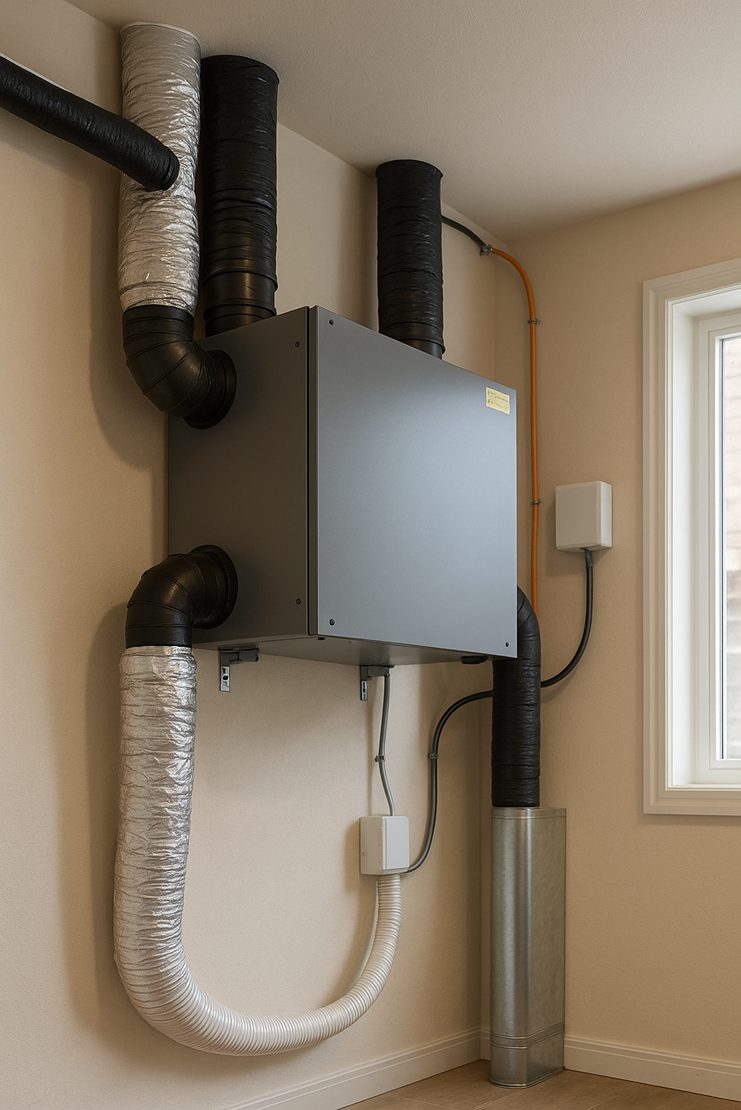
An Energy Recovery Ventilator (ERV) is a balanced ventilation system that brings in fresh outdoor air and exhausts stale indoor air while transferring heat and moisture between the two airstreams. The result: continuous fresh air with minimized heating/cooling penalty and improved indoor air quality (IAQ).
Continuous dilution of CO₂, VOCs, odors
Less dryness in winter, less stickiness in summer
Recovers a large share of heat (and latent energy) that would otherwise be lost
Helps avoid negative/positive pressure problems
Built-in filtration reduces dust and outside pollutants entering living spaces
Final sizing should follow local code and a proper ventilation design; the points below are homeowner-friendly guidelines.
Many homes land in the 60–150 CFM total ventilation range, depending on size, bedrooms, and occupancy.
Bedrooms, living/family rooms.
Bathrooms, laundry, mudroom, sometimes near (not replacing) the kitchen range hood.
• Dedicated ERV ducting = best IAQ and balancing (supply/return grilles)
• Simplified (tied into furnace/air-handler return) can work when designed correctly
Keep well apart and away from contaminants; use exterior hoods designed for low pressure drop and weather.
Look for low sone ratings and ECM motors.
Quiet, steady fresh air.
Wall bathroom switches, occupancy sensors, or humidity-triggered boosts for showers and cooking.
Newer ERVs can self-adjust to maintain set airflow even as filters load.
Some models include bypass/defrost strategies for cold weather.
Mechanical room, utility closet, or conditioned attic/basement; allow service space for filters and core access.
Some ERVs generate condensate—install a trap and drain as directed.
Use smooth, rigid duct where possible; keep runs short; seal and insulate any ducts outside conditioned space.
Dedicated power; follow local electrical codes.
Balance supply and exhaust airflows; verify CFM at grilles; check for cross-leakage.
No. You’ll still want dedicated spot exhaust in baths and a code-compliant range hood. The ERV handles background, whole-home ventilation.
You can, but continuous low speed is usually best for stable IAQ and humidity. Use boost for showers, cooking, or gatherings.
ERVs typically moderate dryness, not add excess humidity. Proper sizing and balancing are key.
Models use defrost strategies (recirculation, pre-heat, or fan cycling). Choose a unit rated for your climate and install per the manual.
Check filters every few months; clean the core annually. A quick annual inspection keeps performance high.